
Intelligent Pesticide Sprinkling System
An edge-AI precision-agriculture rig: a Raspberry Pi CNN diagnoses plant disease on-site and an ESP32 sprays pesticide only where it is needed — cutting chemical use by up to 90%.
Abstract
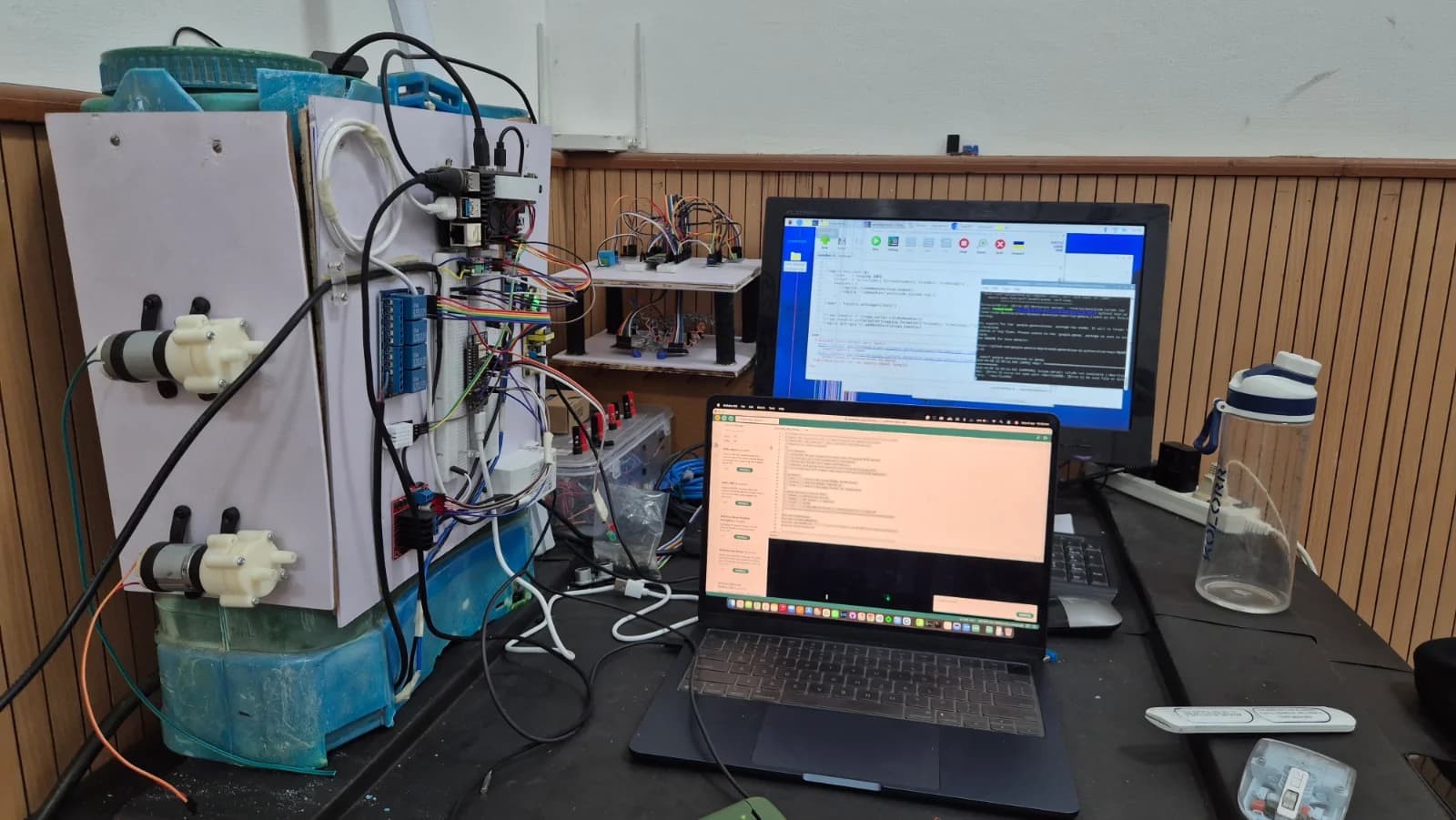
The core challenge in modern agriculture lies in the inefficiency of traditional “blind” pesticide application, which leads to substantial chemical waste, environmental degradation, and high operational costs. This project introduces an automated, data-driven framework designed to optimize pest management through precision agriculture and real-time diagnostic intelligence. By integrating an edge-computing architecture — a Raspberry Pi Zero W running a Convolutional Neural Network — the system performs on-site plant pathology to detect specific diseases and quantify infection severity.
The innovation lies in the transition from broadcast spraying to a targeted, IoT-driven delivery mechanism. High-resolution foliage images and readings from an NPK + pH sensor suite feed the localized CNN, which determines the required chemical dosage. Diagnostic triggers travel over MQTT to an ESP32, which activates a 12 V diaphragm pump and relay system to deliver a precise pesticide spray only to the identified infected zones, while a cloud-linked React/Flutter dashboard provides real-time telemetry and manual override.
The system is applicable from small home gardens to large-scale industrial farms: the MQTT framework lets a single central controller manage many distributed spray actuators, the diagnostic model can be retrained for diverse crop species, and the low-power hardware supports expansion into remote, solar-powered agricultural zones. Current literature reports CNN disease-detection accuracies above 95% and validates that edge computing eliminates the latency issues of cloud-dependent systems in rural areas — positioning this framework to reduce chemical usage by up to 90% while improving overall crop yield.